
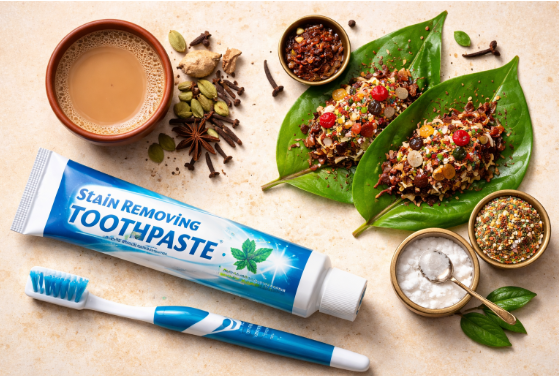
It has also been noted that the Indian people have a higher rate of staining their dentition than their counterparts in other countries. The teeth of Indians encounter special problems of staining, which are directly connected with the cultural diet and genetic disposition, and the environment in which the Indian subcontinent is located. Since the regular consumption of chai and the traditional habit of chewing paan, Indian lifestyles are also the cause of increasing susceptibility to tooth discoloration that requires specialized care and whitening tools.
The Six Major Staining Agents of the Indian Diet and Indian Lifestyle
The Indian dentition is constantly exposed to strong staining agents that are deeply rooted in the cultural aspects and everyday activities. There are six culprits mostly to blame for the high rate of tooth discoloration among Indians, and they are the following:
-
Chai consumption
In India, tea is the major source of dentition staining. Brittle tannins in tea attach themselves to enamel, giving a dismal brown color that is hard to remove. The staining is a build-up, and hence the staining rate is very quick due to the fact that the majority of Indians drink several cups of chai in a day.
-
Coffee drinking
Indians in the urban environment have significantly boosted coffee intake, which contains even more chromogenic and tannin than tea. Besides, the acidic composition of coffee makes it temporarily soft, which makes it more vulnerable to the uptake of the stain.
-
Paan and betel nut chewing
Paan and betel nut chewing produce a severe staining that is very hard to take off and is reddish-brown in color. A combination of the alkaloids of the areca nut and lime paste is known to cause deep pigmentation, which not only occurs on the surface but also permeates the enamel structure.
-
Turmeric use in cooking
Indian food is heavy on turmeric, which subjects teeth to curcumin, a highly colored chemical that leaves a yellow-orange stain. Such stains are mainly shallow, and even though they build up when exposed to daily food, they do so regularly.
-
Tobacco use
Gutka, khaini, and smoking are some forms of tobacco, which form tar deposits and nicotine stains, turning teeth yellow, brown, and black. These stains go deep into the enamel, and they are among the most difficult to remove.
-
Spice-heavy foods
Foods that include saffron, red chili, and other colored substances can build up to cause staining, especially when eaten in an already staining dietary environment.
Hereditary and Environmental Influences That Lead to Staining
In addition to eating habits, there are also several genetic and environmental factors that expose Indian dentition to staining more than in the case of other populations. Studies show that ethnicity has an effect on the thickness of enamel and mineral density; there have been studies indicating that populations of South Asians have a lower average of enamel thickness. The thin enamel gives it a weaker shell to protect the staining agents against the underlying dentin, which is naturally yellow. Therefore, it means that the yellow dentin is exposed when the enamel is weakened.
Teeth Whitening Toothpaste on Indian Staining Agents
To create a good teeth whitening toothpaste to be used by Indians, the surface stains, as well as enamel weakening that intensifies the discoloration, should be taken care of. The best formulation is the multi-mechanism formulation: the existing stain is removed, the additional stain adherence is inhibited, and the enamel is made stronger to prevent further discoloration. The effectiveness of Dente91 Anti-Stain Expert Toothpaste on the specific issues of Indian dentition is based on this inclusive approach.
Generic Whitening Toothpaste vs Indian Specific Whitening Solution
| Feature | Generic Whitening Toothpaste | Dente91 Anti-Stain |
| Stain Target | General surface stains | Chai, paan, turmeric, tobacco-specific |
| Whitening Technology | Basic abrasives or peroxide | Covarine Blue plus chelating phosphates |
| Enamel Protection | None or damaged enamel | Nano Hydroxyapatite strengthening |
| Clinical Results | Gradual whitening over weeks | 63% stain reduction, 80% whitening in 3 days* |
| Sensitivity Risk | High with peroxide formulas | No sensitivity, actually reduces it |
| Chemical Safety | Contains fluoride, SLS, and harsh bleach | Fluoride free, SLS free, paraben free |
| Long Term Health | Progressive enamel weakening | Improves enamel strength with use |
*^Brushing twice-daily | Based on in-vitro study AIMDR 2023; 9 (3) : 211 -219
Dente91 Anti-Stain Expert Toothpaste
The difference between the Dente91 toothpaste and the generic whitening toothpastes is that it is specifically designed with regard to the kind of stains that Indian users are likely to encounter. Whereas Western whitening products are usually optimized to take out wine and berry stains, Dente91 features the stains of chai, paan, turmeric, and tobacco, which are the key issues of the Indian market. This target methodology provides the Indian consumers with better results.
Prevention Strategy & Reduction of Staining
Even though the application of whitening toothpaste is inevitable in the process of eliminating and preventing stains, its application in combination with a wise consumption pattern maximizes the effect of whitening. It is not necessary to sacrifice chai, coffee, and conventional foods, but small changes can significantly decrease staining. An example here is having a straw when taking chai or coffee, which means that contact will be minimal with the anterior teeth, and then rinsing with water immediately will eliminate tannins and pigments before they can settle on the enamel.
In conclusion, one should not brush immediately after eating acidic or staining foods, as waiting at least 30 minutes is recommended. The tea, coffee, and citrus fruit acids temporarily are known to soften enamel; immediate brushing may lead to more damage to softened enamel. Also, the consumption of chai or coffee with milk instead of black will reduce the possibility of staining since the presence of bovine proteins, which bind tannins, will decrease the binding ability of tannins. When a person chews paan or consumes any tobacco product, the best treatment that can be done to prevent tooth staining is to stop doing so entirely, since the products cause the most serious and long-lasting stain.
FAQs regarding Anti-Staining of the Fighting Indian Teeth.
- Why do my teeth stain so fast despite brushing them regularly?
The reason behind the rapid staining of Indian dentition is that all the time they are exposed to a lot of powerful staining agents like chai, coffee, paan, and turmeric, which they take several times a day.
- Is it possible to whiten teeth that are stained with paan and tobacco, or is it permanent?
Paan and tobacco stains are also some of the most difficult to remove, but with the right attitude, they can be minimized to a considerable degree.
- What are the quick results of teeth-whitening toothpaste?
Dente91 Anti-Stain Expert Toothpaste clinical studies show that the stain and 80 percent whitening are reduced in just three days of daily wear.
- Is it necessary to give up chai and coffee and maintain my teeth white?
There is no need to completely quit drinking chai and coffee in order to have a bright smile, but you should change your consumption habits in order to reduce staining.